Tagesausflug
Text auf EnglischAmberd, the Alphabet & Saghmosavank
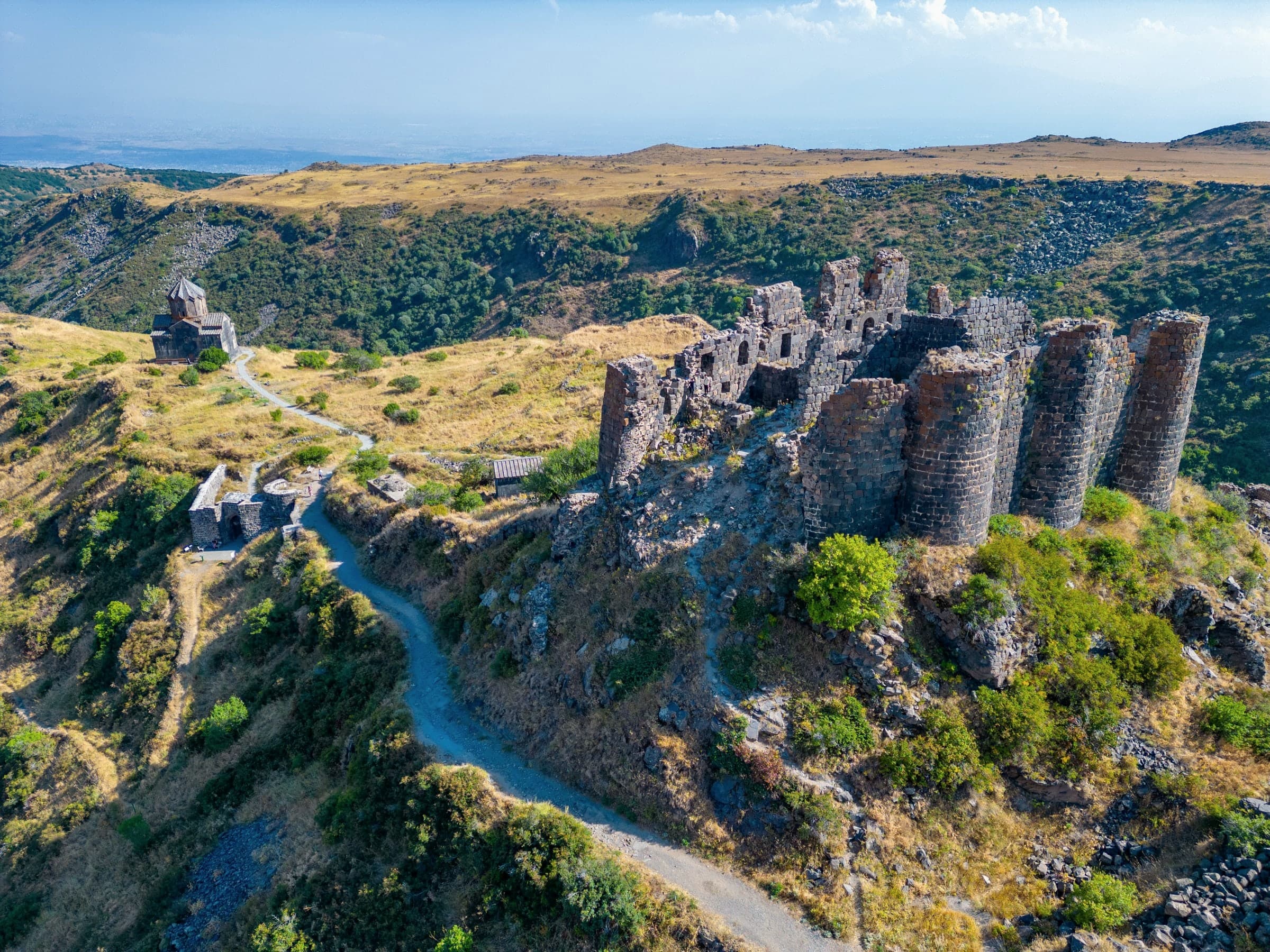
Go high for the fortress. Come down through a village. Meet the alphabet in stone. Finish at the edge of the gorge.
Anfragen kostet nichtsKeine Zahlung über SafarBeantwortet von einem Menschen
Die Geschichte der Route
Start on the mountain. End at the edge.
The day starts high on Aragats, at a fortress so often in cloud that its name is usually translated as “fortress in the clouds”, and comes down from there. Soviet telescopes and a table in the village below. Thirty-nine letters of stone on a hillside. And last, a monastery that once copied books in those letters, on the edge of a gorge, with a path down into it if you want one. Four stops, and each one does something the others do not.
Der Ablauf des Tages
The mountain first, while the high ground is clearest. Then down: a table, the letters, and the gorge last. Every stop has a different job, so none of them is another church in a row of churches.
- Yerevanthe start
- Amberdthe mountain · the peak
- Byurakantelescopes · table
- Alphabetthe letters
- Saghmosavankthe edge · the gorge
- Yerevanby evening
- Up the mountain road
- Down the slope of Aragats
- Into the Kasakh gorge
Auf der Karte
Wohin der Tag führt
Der Tag selbst
Up first, to the fortress, while the air is clear; then down the mountain stop by stop. The dotted green line is the optional walk into the Kasakh gorge.
Wo in Armenien
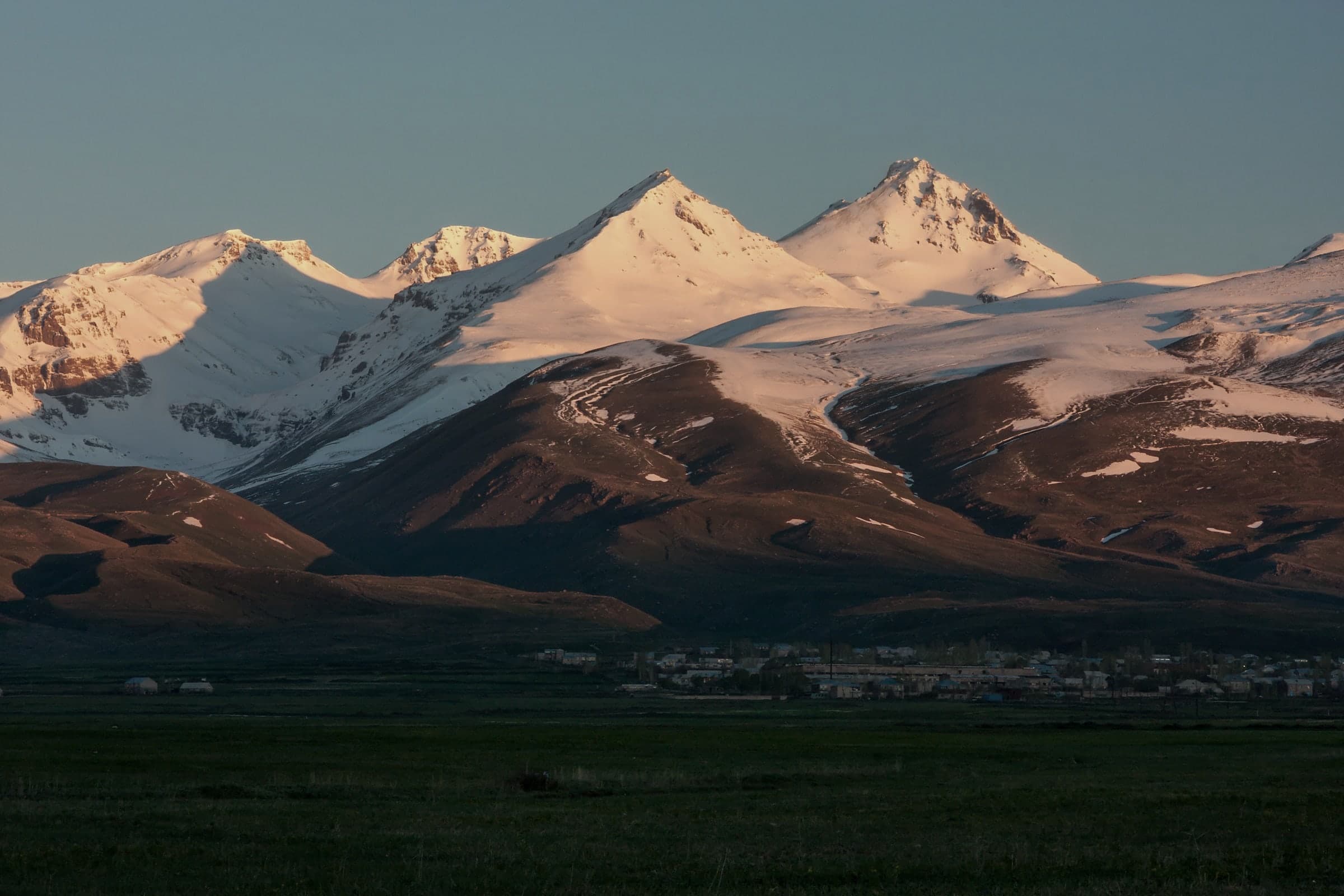
Everything sits on the southern slopes of Aragats, north-west of Yerevan. The distance is short; the climb is what makes it a full day.
- 01 / 04
Go high.
A fortress in the clouds, on the slope of Armenia’s highest mountain.
01AmberdFIRST, WHILE THE MOUNTAIN IS CLEAR
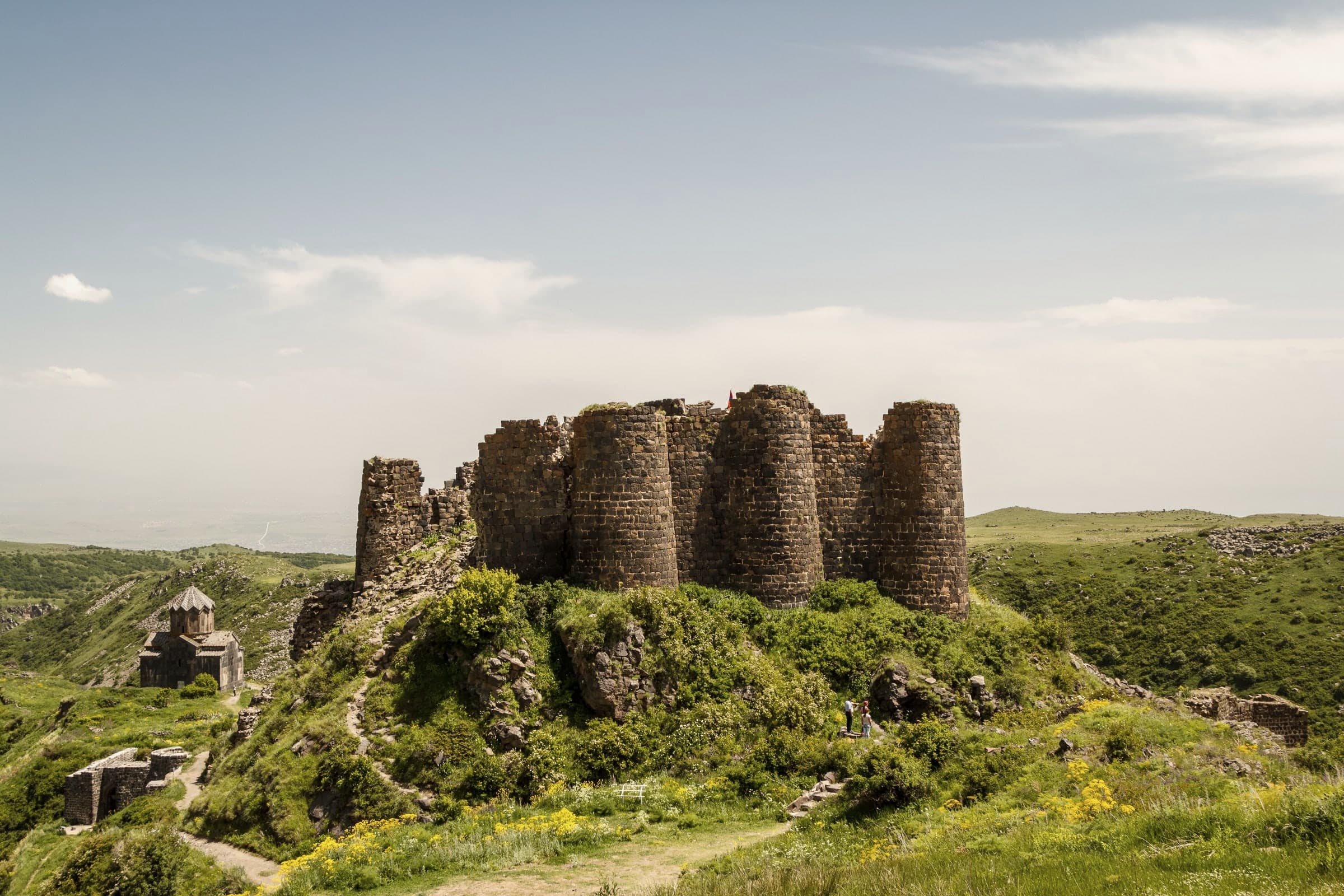
Amberd is often translated as “fortress in the clouds”, and at about 2,300 metres on the slope of Aragats it often is. The walls were begun, it is believed, in the seventh century and made stronger in the tenth. Beside them, the church built by Vahram Pahlavuni in 1026 still stands whole.
The fortress had its own bathhouse, heated from under the floor, and water brought in stone pipes from springs several kilometres up the mountain.
The road up is closed in snow, and parts of the fortress are sometimes closed for restoration. Both are confirmed for your date with your request.
Uneven ground and loose stone inside the ruins; the church and the view need no climbing. It is cooler and windier than Yerevan, so bring a layer.
ACHTEN SIE AUFThe church standing whole beside a fortress that did not.
- 02 / 04
Come down to earth.
Soviet telescopes on a hillside, then a village table.
02Byurakan: the telescopes, then the tableMIDDAY
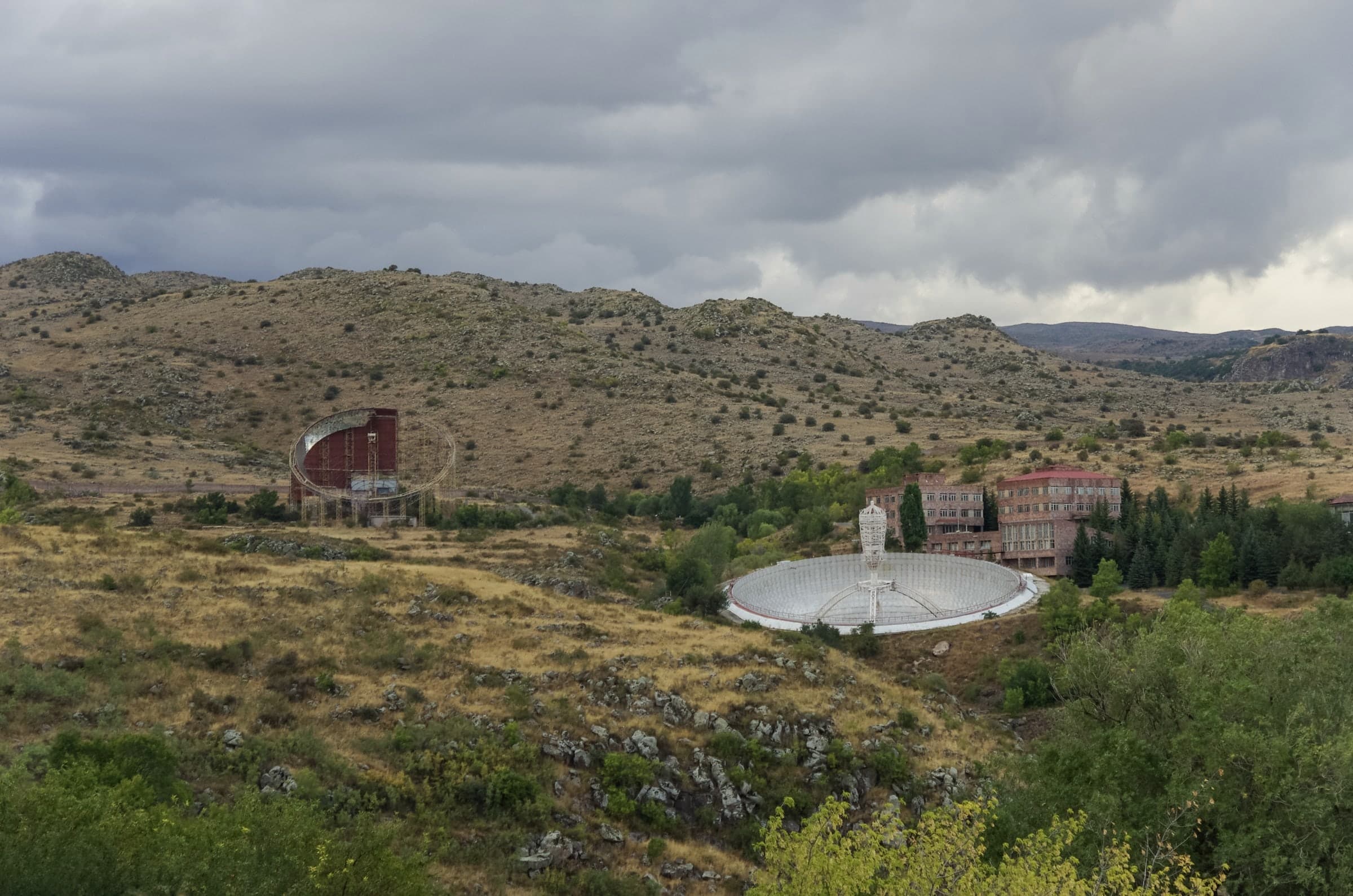
Byurakan is the village below Amberd. On its edge is the observatory Viktor Ambartsumian founded in 1946, where Soviet astronomers watched the sky from the slope of Aragats. Its dishes and domes still stand in the dry hills, some working, some not, and the buildings keep the look of the years they were built in.
Then lunch in the village: after the wind and the stone, a table, a garden and bread from the oven.
The observatory is seen from the road, with a visit inside where one can be arranged. The host and what is served are confirmed with your request.
A short stop at the observatory, then seated.
ACHTEN SIE AUFThe great white dish lying face-up in the grass, pointed at the sky.
Across the slopePER STRASSE
From Byurakan the road runs across the lower slopes of Aragats toward the Aparan road, with the mountain behind you all the way.
- 03 / 04
Meet the letters.
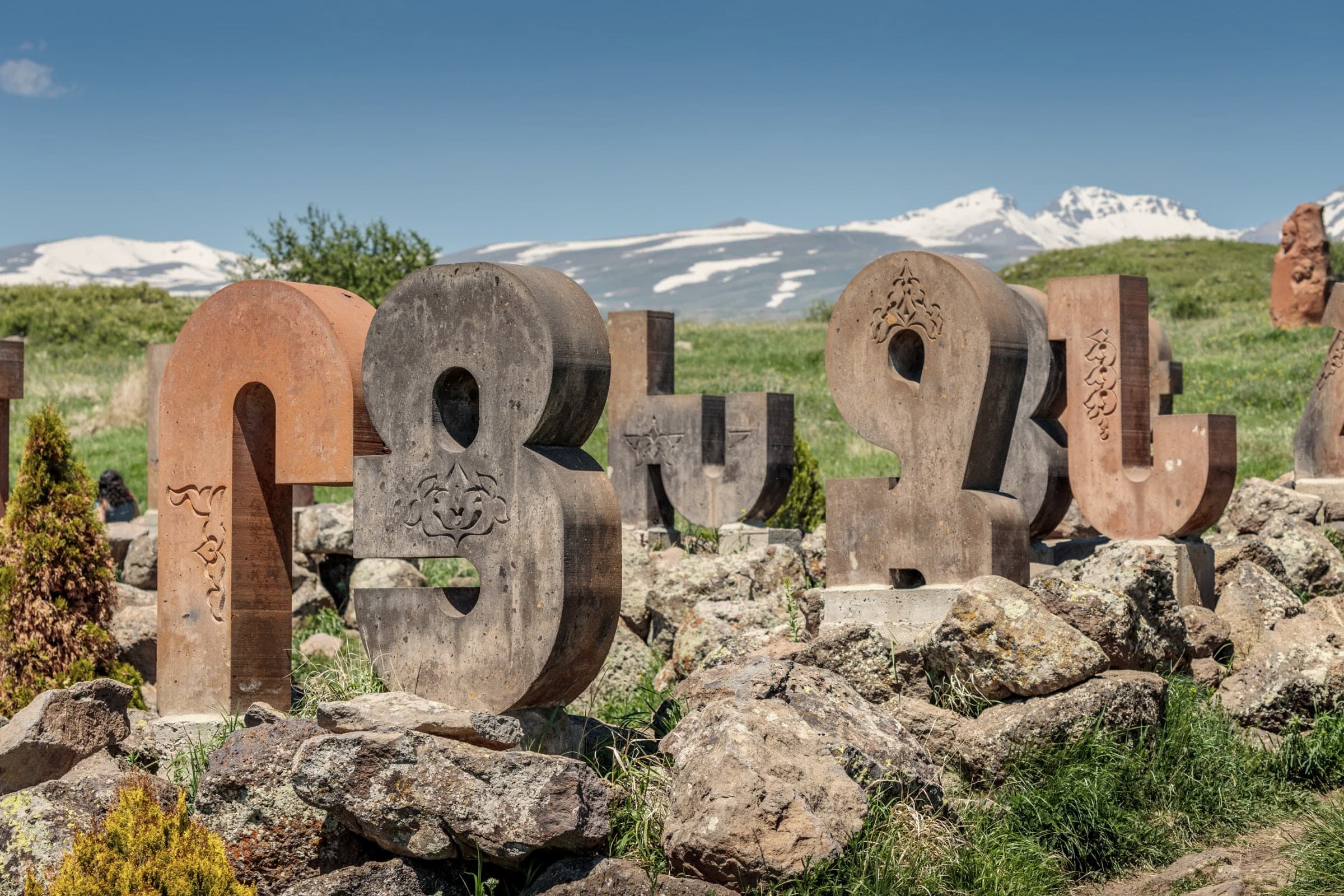
Thirty-nine letters of stone. Language made physical on the slope of Aragats.
03The Alphabet monumentSHORT · ON THE WAY ACROSS
Mesrop Mashtots created the Armenian alphabet in 405, and Armenians still write with it. For its 1,600th anniversary in 2005, all thirty-nine letters were carved in tuff and set out on the slope of Aragats, near Artashavan. Mashtots made thirty-six; three were added in the Middle Ages.
It is a short stop, and a strange one. That is the point of it.
Oshakan, where Mashtots is buried, is a short detour. Ask for it if the alphabet is why you came.
Open ground and a short walk among the letters.
ACHTEN SIE AUFThe letter your name begins with.
- 04 / 04
Go down into the gorge.
A monastery that copied books, and the path below it into the Kasakh canyon.
04Saghmosavank and the Kasakh gorgeLAST, LATER IN THE DAY · WALK OPTIONAL
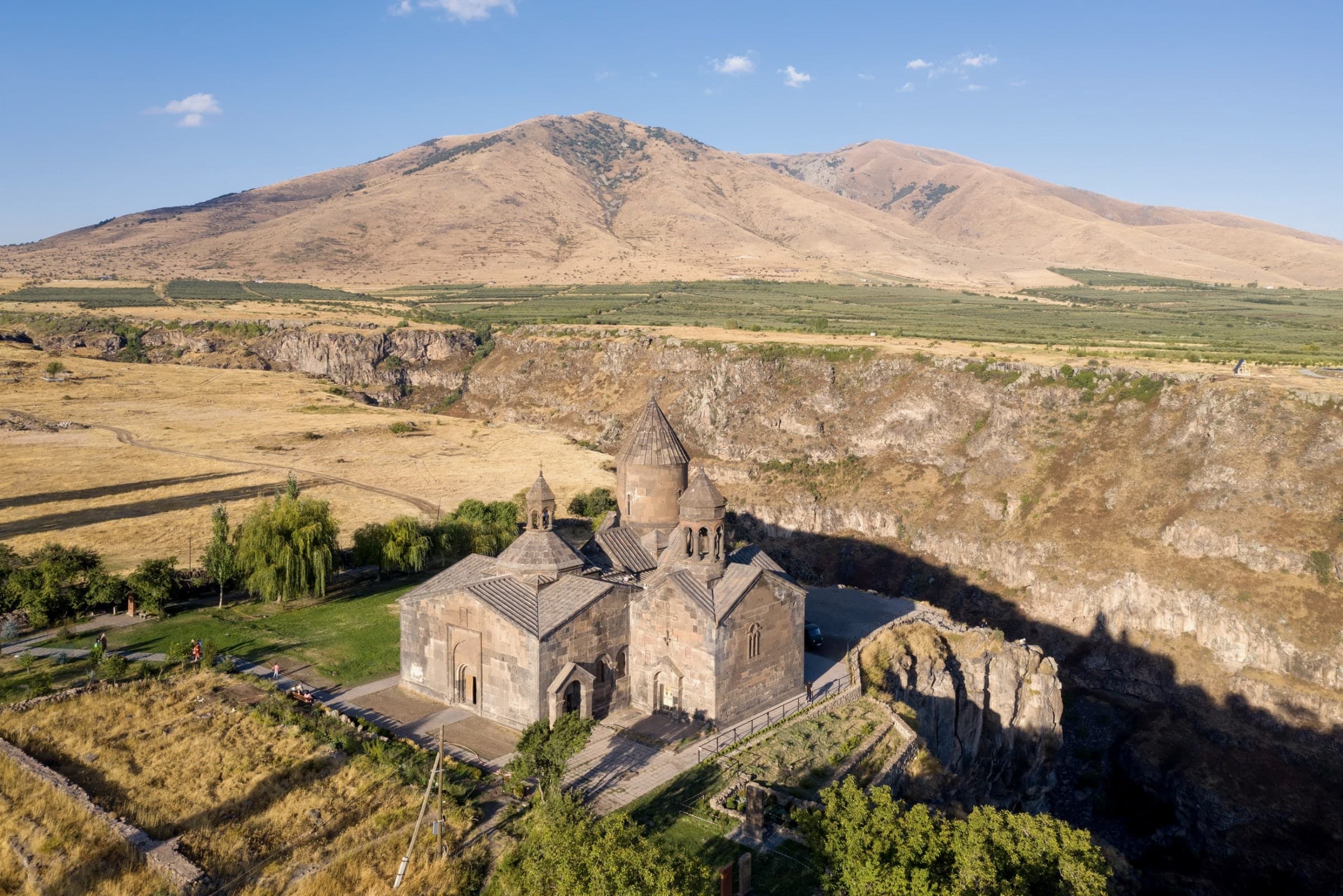
Saghmosavank, the “Monastery of the Psalms”, stands right at the edge of the Kasakh gorge. Its main church was built in 1215 by Prince Vache Vachutyan. In the thirteenth century the monastery kept a writing house and a library, and its monks copied manuscripts in the letters you have just walked among.
Behind the churches, the ground stops and the gorge opens straight down. From there, old restored paths wind into the canyon, toward the river and the caves where the monks once withdrew. Walk down as far as you like, then come back up the same way.
A short walk down and back, optional. The path, its length and whether a guide goes with you are confirmed with your request; in rain it is skipped, because the way down is slippery when wet.
Level ground around the churches. The gorge path is unpaved and steep in places, with the climb back at the end; wear proper shoes. Skip it and the day is still complete.
ACHTEN SIE AUFThe river at the bottom, and the church above you on the rim.
Bevor Sie sich entscheiden
Ist dieser Tag etwas für Sie?
Ideal für
- A day of mountain air after the monasteries closer to Yerevan
- Anyone curious about the Armenian alphabet, and what was written with it
- Travellers who want altitude without a hike
Überlegen Sie es sich zweimal, wenn
- You are travelling in deep winter. Without Amberd this is a different, shorter day.
- You need a view guaranteed. Amberd is often in cloud.
- Uneven ground is hard for you. The ruins at Amberd are loose stone; the church and the view are not.
WHY THIS DAY IS ON SAFAR
Safar gives four stops four different jobs: altitude at Amberd, village life and astronomy at Byurakan, language made physical at the Alphabet monument, and the gorge at Saghmosavank. The day descends as it goes, so each stop changes the register rather than repeating the last one.
Wo dieser Tag in eine Reise passt
A day out of Yerevan, best once you have seen Garni and Geghard. It is the one day in the portfolio that goes high, so it sits well between the gorges of the south and the forest of the north.
Ganz ArmenienEndgültige Details werden vor der Durchführung bestätigt.